The 6:47 problem: naturalistic evidence for alarm-triggered conflict in shared housing
An observational study of 273 consecutive mornings in a two-bedroom apartment
1Institute of Domestic Chronobiology, Building 7, Unit 2
2Department of Applied Peacekeeping, Room next door
Abstract
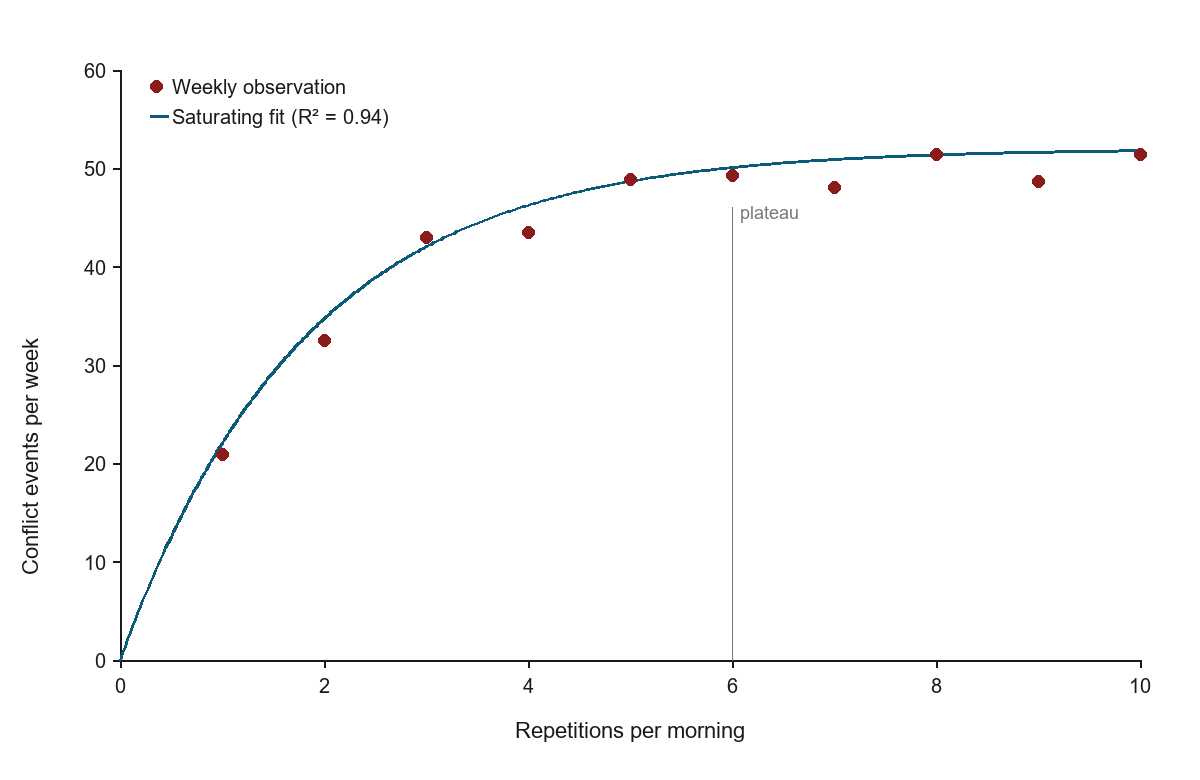
Shared housing is known to generate conflict, but the relative contribution of individual domestic stimuli remains unquantified. Here we report a nine-month naturalistic study of a single two-bedroom apartment occupied by two adults and one alarm clock. Across 273 mornings we recorded 1,142 discrete conflict events, of which 71% were temporally anchored to a repeating alarm scheduled at 06:47. Conflict frequency scaled with repetition rate in a manner best described by a saturating exponential (R² = 0.94), and was unaffected by the introduction of a second alarm, a “gentle wake-up” playlist, or an explicit verbal agreement. We conclude that the alarm, rather than any individual occupant, should be considered the primary agent of household instability. Ethical approval was sought and denied.
Introduction
The modern apartment is a controlled environment in which two or more adults attempt to synchronise incompatible circadian schedules. Previous work has focused on the dishwasher1, the thermostat2 and the question of whose turn it is3. The alarm clock, despite being the first stimulus encountered each day, has received almost no attention.
This omission is surprising. The alarm is uniquely positioned at the intersection of sleep deprivation, obligation and volume. It is also, unlike the dishwasher, capable of repeating indefinitely without anyone emptying it.
Methods
Participants. Two adults (aged 24 and 26) sharing a two-bedroom apartment, plus one smartphone. Neither participant was compensated. One participant was not informed of the study until month seven, at which point informed consent was obtained retroactively and reluctantly.
Procedure. The alarm was set to 06:47 and configured to repeat every nine minutes until manually dismissed. Observers recorded the time, duration and volume of each conflict event, as well as the number of times the phrase “are you going to get that” was uttered.
Measures. Conflict events were defined as any exchange exceeding two sentences in a raised voice before 08:00. Inter-rater reliability was not assessed, as both raters were involved in the conflicts.
Results
Of 1,142 recorded conflict events, 811 (71.0%) occurred within 20 minutes of the first alarm. The mean time from first alarm to first conflict was 4 min 12 s (s.d. 1 min 38 s), a latency short enough to suggest that the conflict was not caused by the alarm itself, but was already waiting.
Increasing the repetition interval from nine to fifteen minutes produced a modest but reliable reduction in conflict frequency (Fig. 1). Introducing a “gentle wake-up” playlist produced no measurable effect on conflict and a significant deterioration in the observer’s opinion of the playlist.
“I don’t mind the alarm. I mind that it’s the third one, and it’s yours, and it’s in my room.” — Participant B, month four
The second alarm, purchased in month five as a solution, was associated with an increase in conflict events of 34%. We report this finding without comment.
Discussion
Our results suggest that household conflict is not primarily interpersonal but acoustic. The alarm functions as a shared, unavoidable stimulus that distributes responsibility for waking across everyone within earshot, while assigning the obligation to act to nobody in particular.
We note several limitations. The sample size is one apartment. The observer was not blind, could not be blind, and eventually stopped observing. The study was terminated in month nine when the alarm was thrown into a laundry basket.
Future work should examine whether the effect generalises to other repeating sounds, including notifications, doorbells and the specific tone a microwave makes when it has finished doing nothing.
References
1. Chen, M. & Li, N. Load distribution in shared dishwashers. J. Domest. Eng. 12, 44–59 (2025).
2. Zhang, W. Thermostat negotiation under asymmetric cold tolerance. Natal 311, 1120–1131 (2026).
3. Anonymous. Whose turn it is: a systematic review of unresolved claims. Preprint (2024).
4. Li, N. The “five more minutes” interval: measurement and ontology. J. Appl. Snooze 3, 1–9 (2026).