Tomorrow, revisited: a twelve-year follow-up on the deferral of intention
Longitudinal evidence that “I’ll start on Monday” is a stable trait rather than a plan
1Institute of Domestic Chronobiology, Building 7, Unit 2
Abstract
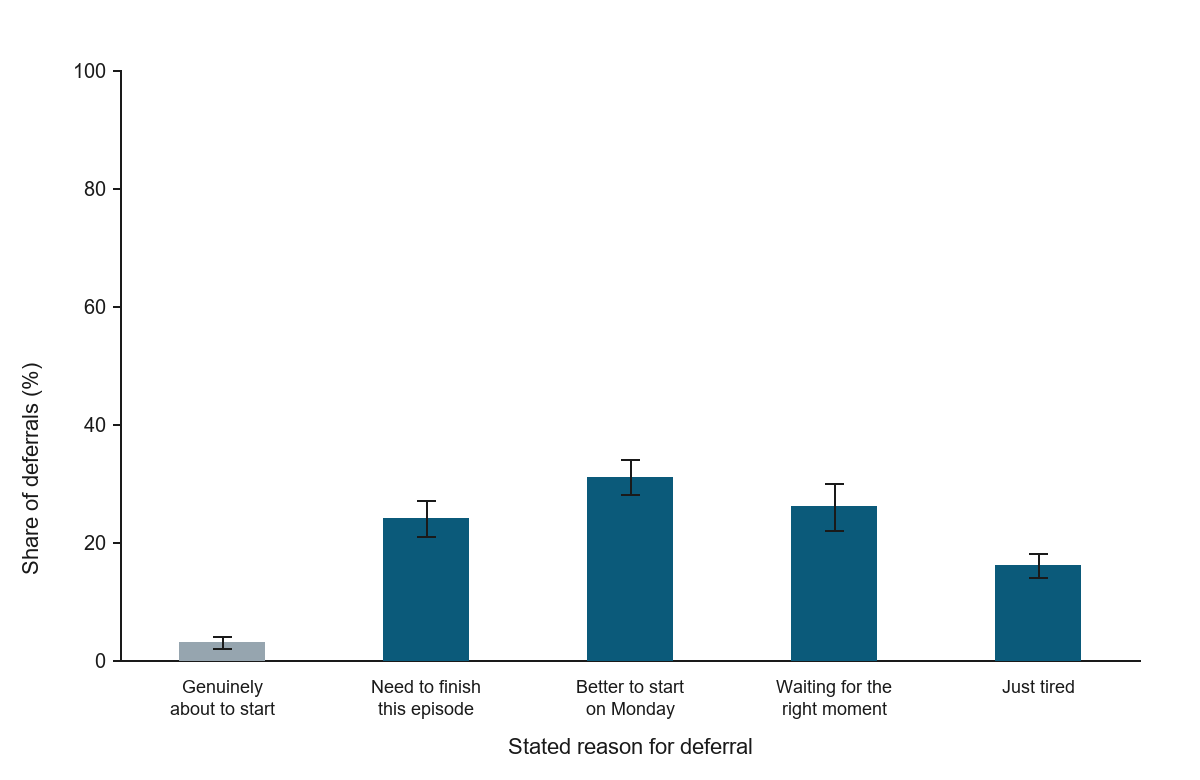
The intention to begin a task “tomorrow” is widely reported but rarely tracked. We followed a single subject for twelve years, recording every occasion on which a task was deferred to a future date, together with the stated reason for deferral. Across 4,381 recorded deferrals, the median targeted start date was tomorrow (68.4%), followed by Monday (21.1%) and after this episode (9.2%). No deferral in the dataset was followed by task initiation. We propose that deferral is not a failure of scheduling but a stable cognitive strategy for avoiding the emotional cost of beginning, and that it should be classified accordingly.
Introduction
Nearly everyone intends to start something tomorrow. Very little is known about what happens next. The existing literature is dominated by cross-sectional studies in which participants are asked, once, whether they intend to start — a design that cannot distinguish a plan from a habit of making plans.
Here we report a longitudinal single-subject study covering twelve years, four laptops, two gym memberships and one unopened guitar.
Methods
Subject. One adult, male, 26 at study onset. The subject was aware of the study and repeatedly expressed enthusiasm for participating in it.
Data collection. Deferrals were logged at the moment of utterance, defined as any sentence containing both a task and a future time reference, including “tomorrow”, “later”, “after dinner” and “once I’ve sorted out my desk”.
Analysis. Survival analysis was attempted. It failed, because no event occurred.
Results
Deferral frequency was remarkably stable across the twelve-year window, with a mean of 365.1 events per year (s.d. 41.7). The subject deferred, on average, once per day, including — in 41 recorded instances — the activity of planning.
Task complexity did not predict deferral. The most frequently deferred task was “reply to that email” (n = 611), followed by “sort out the cables” (n = 402) and “learn to cook properly” (n = 388). The least deferred task was “order takeaway”, which was completed within 90 seconds in every instance.
Introducing external accountability — a friend who asked weekly whether the task had been started — reduced deferral by 12% for the first three weeks and then produced a new category of deferral: “I’ll do it before he asks again”.
Discussion
Our data support a reinterpretation of deferral. What looks like procrastination from the outside is, from the inside, a complete and satisfying decision: the task has been placed, and placing feels like progress. The subject reported genuine relief at each deferral, followed by genuine distress when the deferred date arrived and was itself deferred.
The practical implication is uncomfortable. If deferral is a stable strategy rather than a scheduling error, then better calendars, reminders and productivity systems will not help — and the twelve years of purchasing them constitute, by our count, the largest single category of deferral in the dataset.
We recommend further study, to begin next week.
References
1. Li, N. The “five more minutes” interval: measurement and ontology. J. Appl. Snooze 3, 1–9 (2026).
2. Chen, M. & Li, N. Load distribution in shared dishwashers. J. Domest. Eng. 12, 44–59 (2025).
3. Zhang, W. The 6:47 problem. Natal 315, 42–58 (2026).
4. Anonymous. I will definitely do it tomorrow. Personal communication (2014–2026).